Fish are the most numerous food animals in the world. An estimated two trillion fish are consumed annually, and seafood demand is expected to nearly double by mid-century. Yet, fish welfare remains poorly understood. Improving fish welfare is not just about compassion for animals; it is also about building a food system that is sustainable, ethical, and trusted. Humane slaughter in fish means that the animal neither experiences nor can recover consciousness at any point from the start of stunning until death. Humane slaughter methods can improve fish welfare, enhance food quality, and meet growing consumer and societal expectations.
The state of fish welfare lags far behind that of land animals. This is partly due to the relative youth of industrial fishing and aquatic farming compared to terrestrial livestock production. It is also due to the complexity of assessing measures of welfare in an aquatic environment, physiological differences between ectothermic and endothermic animals, the diversity of fish species, and the broad range of fishing and aquaculture systems used. Multiple solutions will be required to safeguard fish welfare during slaughter, rather than a universal “one-size-fits-all” approach. For example, a slaughter method that works well for tilapia in warm water may be completely ineffective for salmon in colder conditions. Because fish are ectothermic, many species can remain conscious for extended periods, in some cases minutes to hours, when exposed to common slaughter methods like suffocation, bleeding, or chilling in ice water.
Humane slaughter is both a widely recognized ethical concern and, in many contexts, a legal requirement. It is also a matter of food quality. Stress and poor welfare during slaughter generally reduce the shelf life, texture, and taste of fish. In other words, better welfare benefits both animals and consumers.
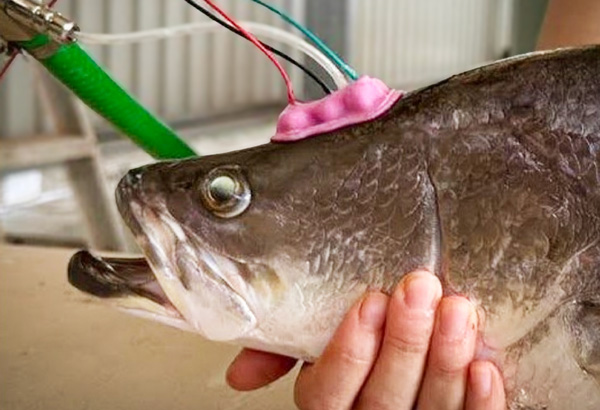
Unlike land animals, fish are rarely slaughtered using methods that have been rigorously validated with electroencephalography (EEG), the gold-standard technique for determining consciousness. Instead, producers must rely on visible signs such as movement or balance, which can be misleading. A fish may appear still, yet remain conscious. This lack of reliable measurement tools has slowed progress. Methods that initially appeared effective for inducing insensibility have later been shown to fall short when evaluated by EEG.
While some laboratory studies have demonstrated promising results for certain species and methods, these findings have not been systematically validated under commercial conditions. At present, no stunning or killing method has undergone the level of rigorous, multi-setting validation needed to confirm it as reliably humane in practice. Without this, there is a real risk that practices promoted as “welfare-friendly” are in fact inadequate. Once a method is labeled humane, it can become entrenched, making it harder to refine or replace. Acceptance of insufficiently validated methods remains a barrier to continued improvement in fish welfare during slaughter.
The path forward is clear:
Policymakers, researchers, producers, and consumers all share responsibility for ensuring that fish, the world’s most numerous food animals, are treated with the consideration increasingly extended to other animals in food production. The pathway forward will be shaped by research, innovation, education, and training.
The lack of reliable measurement tools has slowed progress [in fish welfare]. Methods that initially appeared effective for inducing insensibility have later been shown to fall short when evaluated by EEG.