
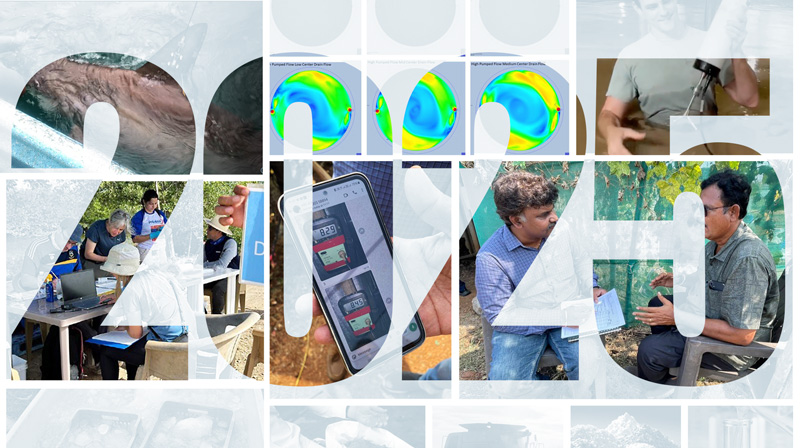
Key Milestones in Spite of Headwinds
U.S. tariffs made 2025 interesting, to say the least. Yet, despite the economic turbulence the global trade war has created, real work went on—and TCRS was right in the middle of much of it. Below are some of the highlights from the year that demonstrate the progress being made in regenerative seafood practices.

TCRS Smallholder Improver Program
The pilot phase of the TCRS Smallholder Improver Program in India is now wrapping up. Made possible by funding from The Nature Conservancy, this phase saw the development of a complete set of standards, interpretive guidance, cloud database, and critical linkages with a digital technology company (AquaExchange), a major processor (Devi Seafoods), a US importer (Aquastar), and a US retailer (Publix Supermarkets). In phase two the program will scale up to include more farms, a network of local assessors and trainers, zone management, and capacity-building in best practices for farm management.

Alternative Feeds Report for World Bank
Aquaculture relies heavily on feed ingredients like fishmeal, fish oil, and soybean meal, but alternatives are needed to support its continued growth while avoiding the risks of overfishing and deforestation. TCRS worked with The Nature Conservancy to produce a report for the World Bank that included an analysis of aquaculture in nascent, emerging, and mature sectors, offering investment guidance and technical insights to support climate-resilient, inclusive, and circular aquaculture growth models. The report highlighted opportunities to utilize food waste, agricultural byproducts, processed animal proteins from rendering facilities, and novel protein sources like single-cell organisms, fermented microbial biomass, and algal oils. The report also offered a deep dive into the opportunities and challenges of insect meal.

TCRS Shrimp Summit
The 2025 TCRS Shrimp Summit gathered a passionate crowd of industry stakeholders in Bali to share and discuss the latest research and innovations impacting all levels of the shrimp value chain. While US tariffs cast a shadow over the outlook for the global shrimp trade, attendees expressed enthusiasm regarding the industry’s future. Dean Akiyama, an industry icon and mentor to many, was honored with a Lifetime Achievement Award; the presentation was just one highlight of the three-day program that included tours of local shrimp farms, which our field collaborators—AquaExchange, Tomota, JALA, and Kytos—equipped with their instruments for real-life demonstration.

Humane Slaughter Through Chill-Killing
Backed by funding from Mobius, TCRS is managing a research project to study the chill-killing of shrimp as a way for smallholder farms to ensure more humane slaughter and maintain product quality. As part of the project, TCRS has commissioned a team from the University of Stirling to first study the effectiveness of shrimp chill-killing in lab settings. The results of the lab study will be further validated in a series of field trials that will compare chill-killing against electrical stunning followed by chill-killing. Insights from the field trials, scheduled for Q1 2026 in India, may find application in the TCRS Improver Program as appropriate.

Fish Welfare at Slaughter
2025 also saw the completion of a two-year project sponsored by the Open Philanthropy Fund to determine the effectiveness of stunning systems in rendering fish insensible to pain before slaughter. The electroencephalograph (EEG) study of brain waves revealed that electrical stunning is not effective in fully stunning certain species like catfish, and that it does not maintain insentience long enough. A proposed third phase will explore new technologies for instantaneous stunning and humane slaughter, as well as develop guidelines for sustainability tracking and reporting.

Hammerhead Shark Conservation
TCRS provided funding to Mike Bolton of Twin Oceans Research for studies aimed to identify threats to critically endangered scalloped hammerhead sharks. By successfully tagging a pregnant female, Bolton’s team was able to confirm Panama’s role as a birthing ground for the species, and subsequently tracked the female’s journey to the Galápagos. Confirming this migratory pathway allows TOR to amplify the need for stronger, science-based fishing regulations to protect these critically endangered sharks, especially in documented birthing and nursery grounds.

Shrimp Tank Optimization
Shrimp farming is one of the most energy-intensive and disease-prone forms of aquaculture. TCRS funded research at Homegrown Shrimp in Indiantown, Florida that used computational fluid dynamics (CFD) software to model various scenarios (e.g., area, depth, bottom slope, drain size, and water velocity) to evaluate tank improvement designs. The first trial demonstrated effective biofloc solids removal, improved water quality, and the potential to upcycle harvested biofloc as a nutritious feed supplement. The CFD optimization process employed in the trial has the potential to improve the design of mainstream intensive shrimp ponds by using improved circulation and solids removal to reduce disease incidence, encouraging biofloc to reduce water exchange and stimulate shrimp growth, and upcycling excess biofloc as a feed supplement to reduce feed costs.

Regenerative Systems
To meet the growing demand for seafood, farming systems are moving to more productive intensive and super-intensive systems. Farming practices must also transform to reduce negative impacts. The ultimate goal is regenerative farming practices that negate carbon emissions, restore ecosystems, and enhance local communities. At the TCRS Shrimp Summit, several organizations demonstrated encouraging progress toward those goals, including Unima, Acuamaya, and Atina, which have sparked improvements to both the local communities as well as the local ecosystems, and OceanLoop and ShrimpVet, which have pioneered systems that are circular and more sustainable.