
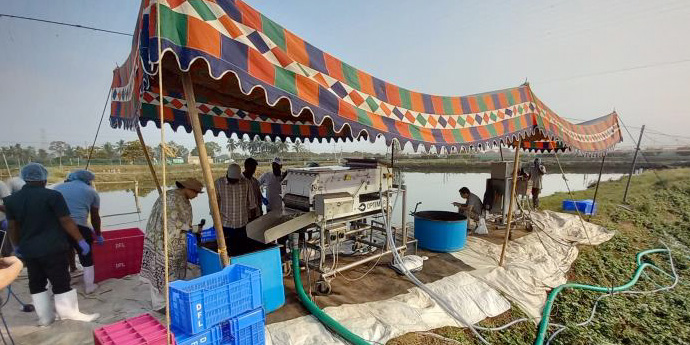
Ethical concerns and market forces have fueled growing interest in developing methods for the humane slaughter of shrimp. TCRS has been actively involved in research to that end, most recently as a sponsor—with funding from Mobius—of field trials that compared the efficacy and welfare impacts of electrical stunning (ES) vs. cold shock (CS) in a farm in India. The trials were organized by Devi Fisheries at one of its contract farms in Andhra Pradesh, and conducted by a team from the University of Stirling led by Dr. Amaya Albalat.
Most shrimp farms in India are small, family-run operations, often without access to a drivable levee, in which case the typical practice is to transport the shrimp in baskets to a processing plant truck, where they are weighed and packed in layers of ice. Because this process often takes at least 10 minutes, most shrimp die of asphyxiation before they are chilled and packed.
Previous laboratory trials conducted by the University of Stirling team evaluated behavioral and physiological responses to in-water electrical stunning followed by cold shock (ice slurry) vs cold shock alone at different temperatures (-2.5 – 5 °C). Physiological measurements included both brain activity and lactic acid concentration in hemolymph. Shrimp immersed in the warmest ice slurry category (+2.5-5 °C) flipped their tails—an avoidance reaction—for up to two minutes. In super-chilled slurry ice (temp <0 °C), the shrimp stopped tail flipping in 20-70 seconds. Electric stunning instantly stopped most shrimp movement, though not all shrimp were effectively stunned.
The April trials in India allowed the team to evaluate stunning methods using large numbers of shrimp and commercial-scale equipment. An Optimar electric stunner device consisting of a conveyer, a water-dripping bar to wet shrimp at entry, four rows of stunning electrodes, and an adjacent control panel to adjust conveyer speed and electrical current was set up beside the harvest pond.
At a conveyer speed of six seconds and an electrical current of 80 volts, animals appeared behaviourally stunned and did not respond to cold shock exposure. Therefore, electrical stunning was effective in abolishing the tail flipping response observed in animals that were placed directly in cold shock. However, data indicates that electrical stunning is, in some cases, reversible. Therefore, best practice would suggest that electrical stunning needs to be followed by cold shock. Shrimp emerging from the stunner often were locked in a jack-knifed position with strong contraction of the tail muscle. Blood levels of lactate were also elevated, indicating muscular activity. A very small percentage (5-10%) of stunned shrimp also had damaged rostrums. Shrimp exposed to a mixture of chunk ice and water reacted with tail flipping followed by inactivity. There was no indication of rostrum damage and blood lactate levels were not elevated.
In summary, to meet ethical and welfare concerns, shrimp benefit from rapid stunning immediately after harvest. Electric stunning provides a rapid and effective stun as shown by the lack of response to subsequent cold exposure, but the process triggers a strong muscle contraction and elevated blood lactate. Cold shock does not deliver an immediate stun. However, colder temperatures are more efficient in reducing the time animals respond to the cold shock solution.
While the project did not evaluate implementation challenges, experts from TCRS explain that the optimal choice of humane slaughter method depends on the pond configuration relative to driveable levees and access to electric power. For ponds without drivable levees, a cold shock at the pond’s edge is recommended before transport to the processing plant truck. For ponds with drivable levees and access to electric power, the electric stunner can provide a rapid and effective stun, but it should always be followed by immersion in ice slurry. For stunning purposes, temperature in the slurry ice is important and should be maintained closer to 0 °C for more than two to three minutes. Thereafter, animals should be kept on ice to ensure animals do not recover prior to death on ice.